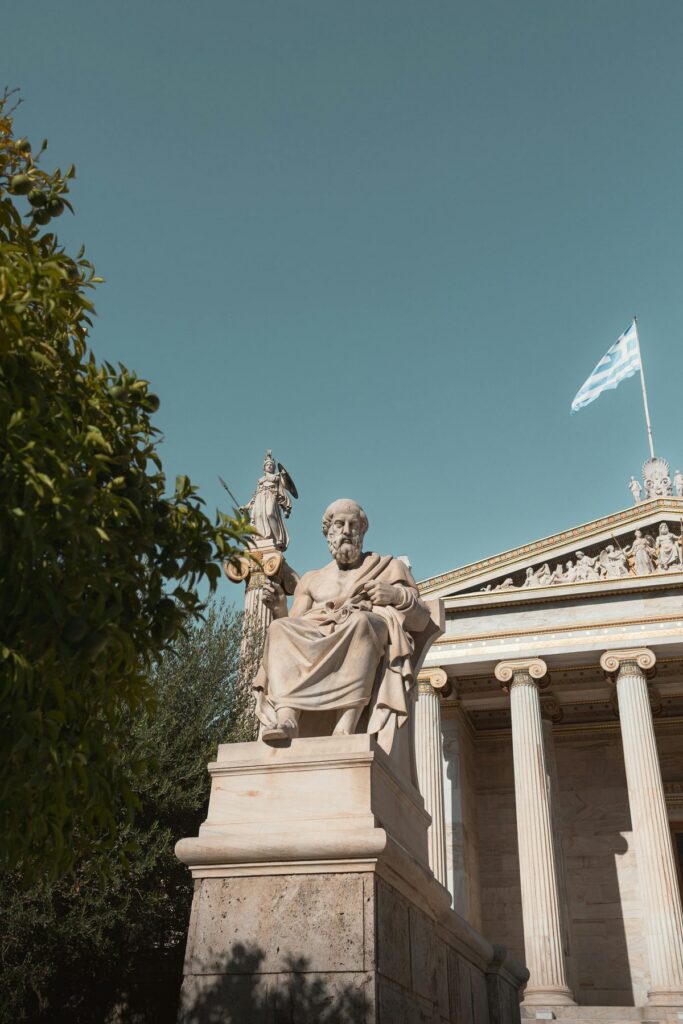
Mary P. Nichols, Professor Emerita of Political Science at Baylor University
To ask “Why study Plato?” is to ask a Platonic question. The question demands that we have reasons for our choices and that we articulate them to others. This is the very thing that the Socrates of Plato’s dialogues is famous for doing, as when he asks the rhetorician Gorgias to explain the art of speaking he possesses, or the sophist Protagoras to explain what his students learn from him. What are their professions? What do they know? Why should someone study what Gorgias or Protagoras teach? What do they learn from them? By the same token what do we learn from Plato? Why study Plato? By depicting his revered protagonist calling for others to give an account of themselves, especially when they teach others, Plato asks us in turn to hold him to account, and his doing so holds us to account as well. It is the human task to examine oneself and to explain oneself to others. As Plato recorded Socrates saying in his Apology, “the unexamined life is not worth living” when he explains his philosophic life to the city of Athens. To ask the questions that Socrates asks, and to ask in turn “why study Plato,” makes sense only if our choices are not mere whims, personal preferences, or even the requirements of a liberal education, which include Plato’s works among the Great Books. If we study them because they are “Great Books,” why are they great? Why do Plato’s works merit inclusion in the curricula of our schools, or in the libraries of an educated person?
Inasmuch as Socrates is known to proceed by questioning others—Plato’s portrayal of his doing so is so compelling that we now call an education that proceeds by questioning a Socratic one—perhaps its merit lies in freeing us from the prejudices of our time. A Socratic education is a liberal one—its goal is human freedom from the strictures of time and place that would otherwise determine us. But does this mean that we are free to determine ourselves? And if so, on what basis do we do so? How can we judge, especially if we live at a time when judgments are considered mere prejudices? Could an education that fosters an “open mind,” for which questions remain open, teach us that we are unable to judge? Such an outcome, however unsatisfactory, is at least consistent with the tolerance required by a liberal political order. After all, Socrates explains that human wisdom is knowledge of ignorance. We might study Plato to affirm our limitations, to help us recognize that there are no authoritative answers, and to support tolerance of others. Advocates of diversity, equality, and inclusion might appeal to Plato as an authority, were they inclined to appeal to any authority at all.
Of course, Plato is more likely to be understood as the enemy of an “open society” than as its friend. The supposedly just city that Socrates describes in the Republic, for example, is hardly a free one, with each member relegated to a fixed social class: workers, warriors, and philosopher kings whose wisdom entitles them to rule. Speculations have been made about a shift in Plato’s thought, from advocating Socratic questioning to presenting answers, even attributing his answers to a “new” figure of Socrates representing Plato himself. Such an account, even if it were accurate, trivializes Plato, and reduces the value of studying his works to understanding his errors: his shift from being a know-nothing to being a know-it-all, from espousing a reason that debunks itself and a freedom without guidance to adopting an authoritarianism that smacks of tyranny.
To find a reason for studying Plato, we mustn’t rely simply on the open-mindedness that might result from Socratic questioning. Help comes from Plato himself, who in the Phaedo portrays Socrates’s reflections on his own educational journey. As a young man, Socrates recollects, he tried to find out “why each thing comes into being, why it perishes, and why it exists.” He looked for assistance in the Great Books of his time, such as that of Anaxagoras, who claimed that “mind arranges and causes all things.” But Anaxagoras did not explain what Socrates was seeking—to understand why mind’s arrangements were the best they could be. In fact, Anaxagoras and other such thinkers neglected the good as a cause and reduced everything to material causes (mist, air, water). When the scientists of his time could not answer Socrates’s questions, he adopted another route—conversations with others about themselves.
Socrates’s discussions with others about their lives, their choices, and the goods they seek demonstrate not only human freedom and responsibility but also their desire for the good, both to know and to attain it. In teaching rhetoric, for example, Gorgias gives his students a means to achieve power over others, but when Socrates asks him if he also teaches his students to be just, he is ashamed to admit otherwise. Later in that same dialogue Socrates shows an advocate of pleasure that there are some pleasures that even he cannot accept. In drawing attention to such limits, Socratic education becomes a moral one, not because he imposes some moral understanding on his interlocutors, but because he lets them discover a goodness in themselves that they neglect at the cost of self-contradiction and that must be developed and guided by thought.
As to the Republic, Socrates allows and even encourages his interlocutors to question what he says, claiming that he too questions it. The freedom denied in the city Socrates describes is at work in their conversation, which acts as a foil to the authoritarian city. Socrates may not have been able to discover with any certainty a transcendent cause that explains the world, inseparably omniscient and beneficent. But he found both intelligence and goodness and much room for improvement in those with whom he conversed and in himself when he conversed with them.
Socratic education supports human freedom, though not the freedom derived from questioning everything, which provides no guidance about how to live. Freedom so understood opens the door to anarchy and consequently to tyranny. Plato in fact warns against these dangers in the Republic when Socrates explains how tyranny emerges from an anarchic politics and a moral relativism, in which all values are held to be equal and no choice better than any other. Rather, the Socratic questioning of Plato’s dialogues comes from a free human being and is addressed to free human beings. Socrates prompts his interlocutors not simply to question, but to seek (better) answers, which awakens and encourages his interlocutors’ desire for the good and hence the moral purpose that elevates human actions. This of course cannot happen without thinking about who we are and about our place in the world. The human freedom that Socrates assumes in his questioning, and which his interlocutors grasp in trying to answer them, is fully realized in the development of the moral and intellectual virtues that questioning cultivates. The liberally-educated human being is Plato’s answer to both anarchy and tyranny, and hence the foundation for self-government. This is why we should study Plato.